

EyeScreen
Safeguarding your child's windows to the world.
Importance of Paediatric Vision Screening
Why should I have my infant / toddler’s eyesight checked?
Singapore is often referred to as the myopia capital of the world. According to the Singapore Health Promotion Board (HPB) in 2023, about 26% of children are already short-sighted by the age of seven¹. The frequent use of digital devices, such as smartphones and tablets, may further accelerate this trend in young children.
Other eye problems such as Strabismus (Crossed Eyes), Amblyopia (Lazy Eye) can usually go unnoticed until your child starts schooling. If lazy eye is only detected after the age of 8, it may not be possible to reverse the eye damage2. Early detection of lazy eye is important because treatment tends to be more effective the younger the child is, especially before the age of four3.
Untreated Strabismus and Amblyopia may lead to permanent visual impairment, and could pose as stumbling blocks to jobs that require good vision in both eyes, such as a pilot and certain doctor specialties, like ophthalmology. Any undetected and uncorrected vision problems in your child could also result in reading and learning difficulties4.
3 reasons to get your child’s vision screened
Early detection
The purpose of paediatric vision screening is to allow early detection of vision problems in children as young as 6 months old.
Early intervention
The earlier an eye problem is detected, the earlier the appropriate treatment could be recommended for your child to prevent permanent visual impairment.
Timely vision screening
The American Optometric Association (AOA) recommends a child to have their first vision screening between 6 and 12 months of age, even if no eye problems are apparent¹.
Eyescreen vs Free School Screening
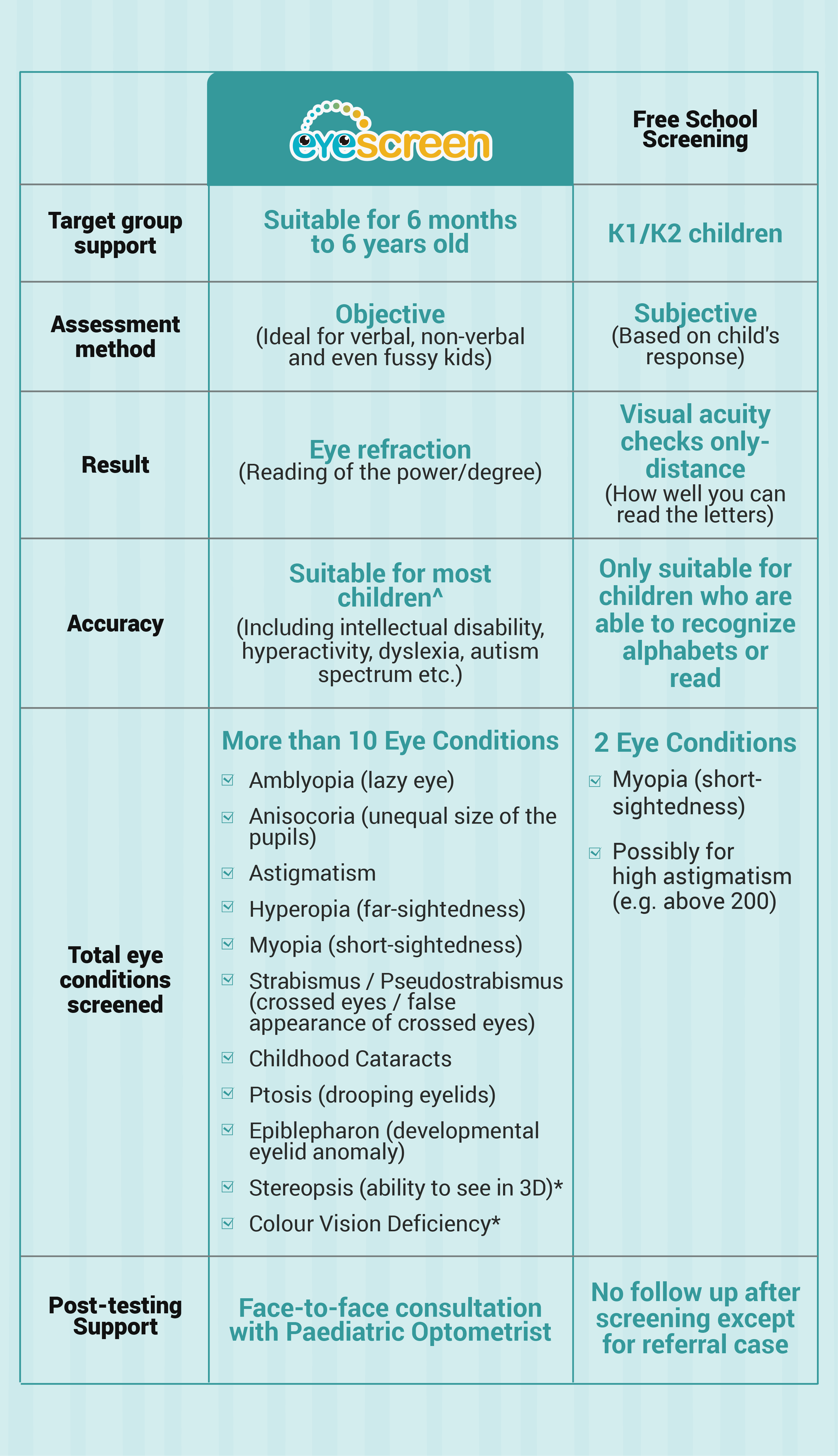
How do we screen?
Eyescreen is a speedy, safe and non-invasive screening that does not require any physical contact with your child or eyedrops to dilate the pupils. By following steps 1-2-3-4, Eyescreen is able to detect eye problems and hence, allowing effective treatment to be administered as early as possible.
Step 1
Assess

Your child's vision development will be assessed.
Step 2
Screen

Your child will be photo-screened by our paediatric optometrist.
Step 3
Further tests

Your child will be routed for supplementary testing (optional) if he or she is older.
Step 4
Result

You will receive screening report on the spot after screening.
Disclaimer
*For children aged 3 years and above.
^Kindly enquire for more information prior to registration.
References:
¹Ministry of Health Singapore. Effectiveness of National Myopia Prevention Programme’s Strategies for Primary School Students. Published March 6, 2024. Accessed September 26, 2025. https://www.moh.gov.sg/newsroom/effectiveness-of-national-myopia-prevention-programme-s-strategies-for-primary-school-students